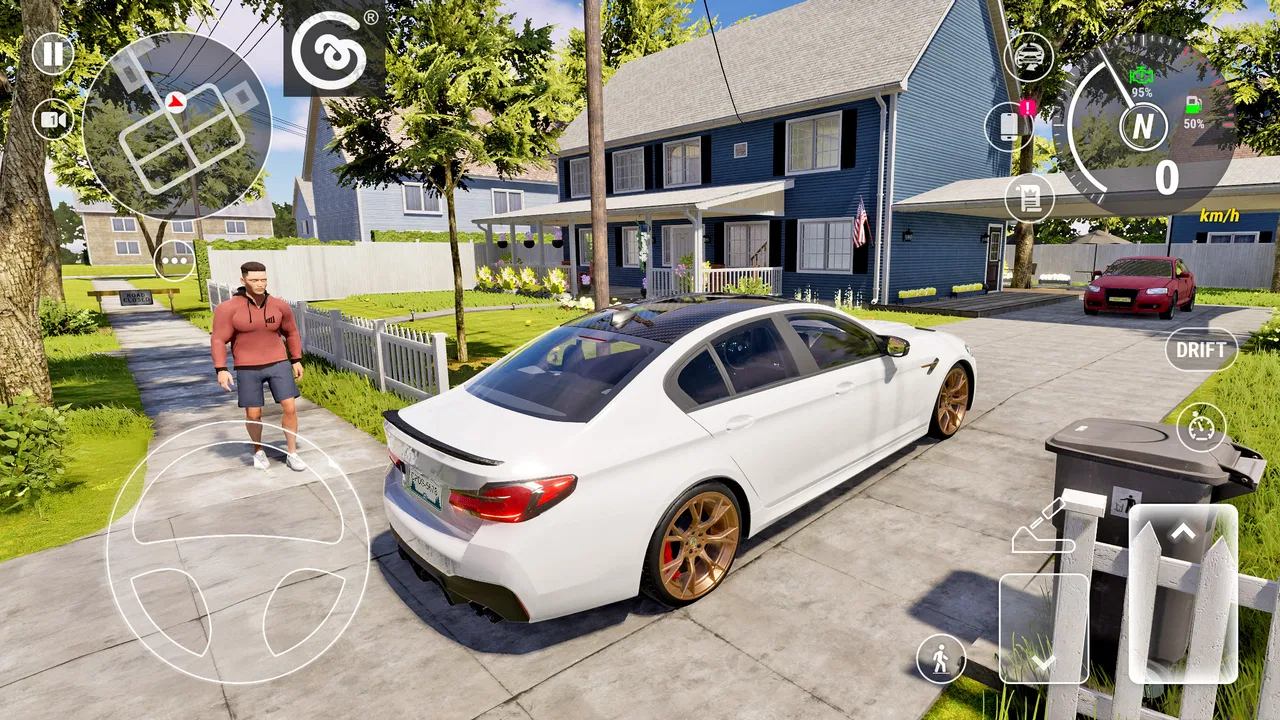
Car Parking Driving School
- 4.5
- Rating
- 10.00M
- Installs
- Free
- Price

 Analysis by App-foxy
Car Parking Driving School is the kind of simulation game I open when I want driving to feel deliberate rather than frantic. Instead of treating every vehicle as an excuse to race toward the next checkpoint, it puts attention on steering, positioning, reversing, and fitting a car into spaces without scraping through the exercise. That focus makes it more patient than most mobile driving games, but it also gives it a clear identity: this is best enjoyed as a practice-oriented parking game, not as a full replacement for an open-world racing title.
My overall impression is positive because the game combines a large driving environment with a substantial selection of vehicles and multiplayer play. It comes from Racing Games Android - Appsoleut Games, is free to start, and is rated for Everyone. With a 4.5 average from around 123 thousand ratings and over 10 million installs, it has clearly found an audience beyond a small niche of parking enthusiasts. I can understand why: the basic idea is easy to grasp, yet careful driving gives the game more depth than its simple premise suggests.
Why the driving feels more involved than a typical parking game
The strongest part of the experience is the change in pace. In a normal racing game, I can often recover from a poor corner by accelerating and taking a wider line. Here, a bad approach to a parking space tends to stay bad. I have to think about the angle of the car, the available room, and how much steering input is useful before committing to the final movement. That creates small decisions that are easy to overlook in a racing game but become the entire challenge here.
You May Also Like

 Blood Strike: 2.5 Anniversary
Blood Strike’s Loadouts Turn Every Drop Into a Tactical Gamble
A close look at Blood Strike’s custom loadouts: how fast access to signature weapons reshapes its battle royale rhythm, rewards preparation, and narrows the gap between fights.

 Pandora - Music & Podcasts
Pandora’s Music Is Easy to Start, but Harder to Recover
Pandora’s strength is its low-effort path from a seed to a station. Its weak spot is how much confidence it asks you to place in connection, setup, and quiet recovery.

 8 Ball Pool
 Is Built on Rivalries, Rematches, and Routine
A close look at the rivalries, rematches, shared routines, and unanswered safety questions that turn a quick pool match into a persistent mobile community.

 Samsung Music
’s Quiet Strength Is Playing What You Already Own
Its reach comes less from spectacle than from dependable access to a personal library. That simplicity is both the app’s strongest retention engine and its ceiling.

 AccuWeather: Weather Radar
AccuWeather Review: A Quick, Clear Forecast for Everyday Decisions
For everyday plans, the best forecast is the one you can understand quickly. AccuWeather makes rain timing, radar, and local conditions easy to act on, with a few trade-offs.

 Hill Climb Racing
Why Hill Climb Racing Still Turns Crashes Into One More Run
A tiny car, a bumpy hill and one more upgrade: Hill Climb Racing keeps resurfacing because its simple chaos makes every near-miss feel personal.
More From Our News Desk



The large open world also gives the game room to breathe. A collection of isolated parking screens can become repetitive quickly, especially when each task asks for nearly the same maneuver. Driving through a broader environment makes the transition between exercises feel less like selecting a menu item and more like spending time behind the wheel. I found that useful when I wanted to practice controlling the car before attempting a tighter parking task.
The vehicle variety adds another layer to that idea. The game offers more than ninety customizable cars, so the driving experience is not tied to one permanent vehicle. That matters because a car that feels comfortable for a beginner may not be the one I prefer once I start paying closer attention to turning space and body length. Trying different cars also keeps the open-world portion from feeling like a single repeated routine.
Customization is most valuable when I treat it as a way to make the garage feel personal rather than as a promise that every vehicle will behave completely differently. I would not approach the game expecting a detailed mechanical workshop. Its appeal is the combination of choosing a car, adjusting its appearance or identity, and then taking it into a parking-focused environment. For casual players, that is enough to create a sense of progression without demanding the complexity of a dedicated racing simulator.
Multiplayer changes the mood considerably. Parking alone is quiet and methodical, while playing around other people can make the same driving space feel more social and unpredictable. I like that contrast because it lets the game serve two different purposes. I can use it as a calm solo activity when I want to concentrate, or treat it as a more playful driving session when I want interaction. The trade-off is that multiplayer is naturally less controlled; a careful practice run can become distracting when other drivers are sharing the environment.
Controls reward patience, not constant correction
For me, the most useful way to approach the controls is to make smaller inputs than I initially expect. Parking games often tempt players to turn too much, notice the mistake late, and then swing in the opposite direction. That produces a chain of corrections that makes a simple maneuver look harder than it needs to be. I get better results by slowing down before the final approach, straightening the car early, and using reverse as part of the plan rather than as an emergency response.
This is also where the game separates itself from arcade driving alternatives. A conventional mobile racer usually rewards speed, dramatic overtakes, and quick reactions. Car Parking Driving School rewards awareness of space. If I am playing while tired or impatient, the experience can feel slow. When I am in the right mood, that slower rhythm is exactly what makes it satisfying.
A practical everyday use case is a short break between tasks. I can play a few parking exercises without needing to follow a long story or remember a complicated control system. The game fits that situation well because each attempt has a clear immediate goal. However, I would avoid starting a difficult maneuver when I only have a minute to spare. The frustration comes from rushing the final alignment, and the game is much fairer when I give myself enough time to position the car carefully.
What the open world adds—and what it cannot replace
The open world is a meaningful strength because it prevents the game from feeling like a stack of disconnected tests. I can drive between activities, get familiar with the environment, and change the way I think about parking. A space that looks simple when approached from one direction may feel awkward from another, which encourages me to look ahead instead of treating every task as a fixed button-press sequence.
At the same time, I would not confuse a large driving area with the kind of deep world found in a dedicated open-world racing game. The main reason to explore here is to support the driving and parking loop. If my priority is high-speed competition, extensive story content, or a broad range of racing events, another category of game will probably suit me better. This title is at its best when the open world supports careful car control rather than when I expect it to become a complete driving lifestyle.
The same comparison applies to simulation games that focus on realistic vehicle systems. Car Parking Driving School gives me a more accessible experience than a demanding simulator built around technical tuning or professional racing procedures. That accessibility is a benefit for newcomers, younger players, and anyone who wants a relaxed driving game. The compromise is that experienced simulation fans may find the model less detailed than they want.
The main weakness is repetition and the cost of perfection
The biggest limitation is the narrowness of the central activity. Parking is the point, and the game does not hide that, but the basic challenge can begin to repeat once the novelty of the world and the garage wears off. I notice this especially when several attempts require similar positioning. The difference between a satisfying session and a dull one depends heavily on whether I am still interested in improving my approach.
There is also a particular kind of friction in games that judge careful movement. A small error can force me to repeat a task that felt almost complete. That can be motivating when I know exactly what went wrong, but irritating when I believe the maneuver was acceptable and the game disagrees. Players who prefer forgiving arcade handling should be prepared for more trial and error here.
The free-to-play structure deserves attention before downloading. The game is free, but optional in-app purchases range from $0.99 to $104.99 per item. I would recommend treating the free version as the test: spend time with the basic driving loop first and decide whether the extra customization or convenience is genuinely worth paying for. The wide range in purchase prices means a careful player should avoid making a quick decision simply because the game is enjoyable in the first session.
That payment model does not automatically ruin the experience, but it changes how I evaluate the garage. A large vehicle collection is exciting, yet I would not assume that owning more cars will solve every driving problem. Better results still come from learning the approach, controlling speed, and understanding the space around the car. If I am tempted to spend only because I failed a parking challenge, I would pause and try changing my technique first.
Who will get the most from it
I think the best audience is anyone who enjoys vehicle games but wants a slower, more precise alternative to racing. It works particularly well for players who like repeating a maneuver until it feels natural, comparing different cars, and moving between structured parking tasks and free driving. The Everyone content rating also makes it approachable for families, although younger players may still need guidance around optional purchases on the device.
It is also a good fit for someone who wants a casual multiplayer driving space without committing to a serious competitive racer. The social element can make ordinary driving more entertaining, especially when I am playing with friends who enjoy experimenting rather than chasing the fastest possible result. I would still choose solo play when I want focused practice, because other drivers can make the environment busier than the parking challenge requires.
On the other hand, I would skip it if my ideal car game is defined by speed alone. Players looking for constant action, aggressive racing, or a highly technical simulation may be happier elsewhere. I would also hesitate to recommend it to anyone who dislikes repeating a task after a minor mistake. The game asks for patience, and that is not a weakness for the right player, but it can feel like unnecessary friction for someone who wants instant movement and generous recovery.
Before installing, I would check device compatibility. The current version is 9.19.6 and requires Android 7.0 or later. That makes the technical entry point fairly accessible for compatible Android devices, but the practical experience can still vary with screen size, controls, and how comfortably the phone handles a large driving environment. I prefer testing the controls in a quiet session rather than judging the game during a rushed first launch.
Small habits that make the game more enjoyable
My first tip is to separate learning the car from completing the task. I spend a little time observing how wide the vehicle turns and how much room it needs before attempting a difficult parking position. This avoids blaming the challenge for a mistake caused by unfamiliar handling. With a selection of customizable cars, it is worth finding one that feels predictable before moving to a vehicle chosen only for its appearance.
My second tip is to use the open world as a warm-up rather than immediately chasing the hardest parking attempt. A few relaxed turns help me settle into the steering sensitivity and notice whether I am overcorrecting. This is more useful than repeatedly restarting a challenge while making the same first approach. The world becomes part of the practice routine instead of just scenery between objectives.
My third tip is to treat reversing as a planned movement. I try to line up earlier, leave enough room for the rear of the car, and make one controlled correction instead of several hurried ones. This is a small change, but it makes the game feel less random. It also gives the parking exercises a clearer logic: I am solving a space problem, not simply trying to make the car touch a target.
Finally, I would use multiplayer for variety, not as the only way to judge the game. The shared environment can be fun, but it is not the best place to learn a precise maneuver. Solo sessions reveal whether I genuinely enjoy the core simulation, while multiplayer shows whether the social layer adds enough energy to keep me returning. That distinction helps avoid confusing temporary excitement with lasting interest.
My verdict after looking at the complete package
Car Parking Driving School succeeds because it understands that parking can be a game in its own right. The large environment, multiplayer option, and broad customizable garage give the simple premise more room than a basic parking challenge usually receives. I especially appreciate the way it rewards controlled inputs and planning instead of allowing speed to cover every mistake.
Its limitations are just as clear. The central loop can become repetitive, careful challenges may frustrate players who dislike retries, and the optional purchase range means I would approach the garage with a budget in mind. It also cannot offer the same appeal as a dedicated racer for people who want nonstop competition or as a deep simulator for players seeking technical realism.
Still, I would recommend it to a friend who enjoys driving games but wants something calmer and more precise. It is free to try, carries an Everyone rating, and has built a substantial audience since its release on June 15, 2018. The best reason to install it is not the promise of speed; it is the satisfaction of making a difficult parking maneuver look simple. If that sounds rewarding rather than restrictive, this simulation game is worth a place on an Android device running Android 7.0 or later.
FAQs for Car Parking Driving School
01What is Car Parking Driving School about?
Car Parking Driving School is a simulation game designed to improve your parking skills through various challenging levels. It offers realistic controls, multiple car options, and different environments to practice parking techniques. The app aims to provide both an educational and entertaining experience for users who want to master parking.
02Is Car Parking Driving School suitable for beginners?
Yes, Car Parking Driving School is designed for users of all skill levels. Beginners will find the initial levels helpful for learning the basics of parking, while more advanced users can enjoy complex scenarios that challenge their skills. Tutorials and hints are available to guide new players.
03Does Car Parking Driving School require an internet connection?
Car Parking Driving School can be played offline, allowing users to enjoy the game without an internet connection. However, to access certain features such as updates, leaderboards, or multiplayer modes, an internet connection might be required. Check the app’s settings for more details.
04Are there in-app purchases in Car Parking Driving School?
Yes, Car Parking Driving School includes in-app purchases. These typically offer additional features, such as unlocking new cars, removing ads, or accessing premium levels. While the game is free to download, these purchases are optional and enhance the gaming experience.
05How realistic are the controls in Car Parking Driving School?
The controls in Car Parking Driving School are designed to mimic real-life driving as closely as possible. Users can choose between different control settings, including steering wheel, tilt, or button controls, to find what feels most intuitive. The realistic physics make the parking challenges engaging and educational.
Pros
- Realistic driving physics enhance learning.
- Diverse car models for varied experiences.
- Challenging levels improve driving skills.
- Intuitive controls make gameplay enjoyable.
- Offline mode available for on-the-go play.
Cons
- In-app ads can be disruptive.
- Some levels feel repetitive.
- Limited customization options.
- Occasional bugs affect gameplay.
- Requires frequent updates for new content.

Car Parking Driving School
Gallery